
As a business communication instructor, you have the exciting opportunity to transform student perceptions of this course. It's one thing to know this material is important, and another entirely to ignite genuine enthusiasm in your students. Here's how to frame the course in a way that resonates with their ambitions and goals:
Start with the "Why"
Paint a relatable picture: "Picture yourself landing that fantastic internship… but then you're asked to present a project plan or tackle a difficult conversation." Connect these anxieties to the solutions this course offers.
Emphasize the Skills That Matter Most
Focus on the benefits students crave:
- Credibility: "Polished communication makes you appear professional, detail-oriented, and capable."
- Persuasion: "Learn to tailor messages, anticipate objections, and make a compelling case for your ideas."
- Relationship-Building: "Foster trust, manage conflict, and become a go-to team member."
- Problem-Solving and Critical Thinking: "Understand how communication works to identify breakdowns, brainstorm solutions, and address challenges."
More Than Meets the Eye: Benefits Beyond the Workplace
Improved communication transforms all areas of life:
- Critical Thinking: Analyze audiences and organize ideas for sharper problem-solving.
- Self-confidence: Express yourself clearly and confidently for success in all your endeavors.
- Problem Solving: Identify root causes of issues and brainstorm solutions by understanding how communication works.
What You'll Actually Learn
Don't think it's just letters and reports! A comprehensive business communication course covers:
- Writing: Master emails, reports, and proposals that achieve your goals.
- Presentations: Deliver engaging, persuasive presentations both in-person and virtually.
- Difficult Conversations: Navigate conflict and workplace tensions with skill.
- Global Communication: Excel in cross-cultural settings and diverse teams.
- Ethics & Technology: Ensure ethical communication and grasp the impact of AI tools.
30 Compelling Reasons Students Need This Course
Whenever you begin a new term, you probably like to emphasize the value of the business communication course to your students. In fact, we like to think there is no other college course that offers as many personal and professional benefits as a well-rounded communication course. Here is our list of 30 ways this course and the skills it develops can help students in their personal and professional lives.
Succeeding in other college courses. From writing research papers to making presentations, the skills developed in the business communication course can help with virtually every other course students take.
Landing the best available job. The job-search process is essentially an interconnected set of business communication projects using a variety of media and interpersonal communication skills. It’s a great opportunity for students to put their finely tuned skills to work.
Positioning oneself for promotional opportunities. The managers who make promotional decisions like to keep an eye on up-and-coming talent, and communication skills play a critical role in how those employees perform and how they are perceived by colleagues, customers, and influential executives.
Communicating effectively in an increasingly virtual workplace. You and your students made heroic efforts to shift to virtual learning during the pandemic. One positive outcome of this has been giving students real-life practice at the long-distance communication tasks they will be expected to excel at in today’s workplace—and a modern business communication course helps by showing students how the communication process works and how to apply it in virtual work scenarios.
Understanding and preparing for the impact of artificial intelligence. AI is being applied in just about every functional area of business, and many of these applications intend to augment or replace human communication. By learning about the AI advances we discuss in our latest editions, students will know what to expect in the workplace and be better equipped to distinguish useful and ethical AI tools from problematic approaches and over-hyped technologies.
Becoming a more-effective online and offline networker. Networking is a vital skill for everyone from entrepreneurs to top-level corporate managers, and business communication equips people with the audience insights and communication skills they need to become valued and successful network participants.
Interacting with people up and down the corporate hierarchy. College-aged students aren’t always comfortable communicating with older, more-experienced colleagues, managers, and executives. Learning how to analyze an audience’s needs and expectations can help anyone handle these challenges with grace and confidence.
Solving problems. Every professional runs into problems in the workplace, and some jobs are all about problem solving. Communication is central to many business problems and challenges, whether it’s part of the problem or part of the solution.
Selling ideas, proposals, and products. The business world is littered with great ideas and well-designed products that never caught on because the people behind them didn’t know how to promote themselves or their marvelous creations. Even professionals who never come close to working in marketing or sales need to know how to persuade—a valuable skill students will learn in this course.
Understanding audiences. Whether it’s the other person in a one-on-one conversation or a global audience on digital media, knowing how to assess someone else’s information needs and emotional state improves every form of communication.
Developing digital information fluency. Finding, evaluating, and using digital information in an age of data overload is a make-or-break skill in many careers.
Developing visual literacy. From infographics to online video, visual media have become a fundamental part of business communication, not to mention the charts, graphs, diagrams, and other tools that have been in use for decades. A well-rounded business communication course can help students understand the power of visual communication, interpret business visuals, and make intelligent design choices in their own documents and presentations.
Developing a compelling personal brand. Even people turned off by the idea of branding themselves can benefit from knowing the behaviors and skills that combine to create the “social being” they present to the rest of the world.
Detecting and avoiding ethical lapses. Ethical dilemmas and ethical lapses should be core topics in business communication, of course. In addition to general guidelines for ensuring ethical communication, our texts offer such examples as overselling, obscuring negative information, and manipulating charts and graphs.
Avoiding and resolving disputes. Understanding how communication works—or fails to work—helps people minimize confusion, avoid inadvertent insults, and keep tensions from escalating.
Diagnosing communication breakdowns. Sometimes even with good intentions and careful effort, communication efforts can fail. Professionals who understand a basic model of the communication process can use it to diagnose breakdowns and take corrective action.
Using communication technology professionally. It’s a rare student who isn’t equipped with some advanced communication and computing technologies these days, particularly one or more mobile devices, but using those tools in a professional context takes the sort of awareness and practice they’ll get in the business communication course.
Enhancing personal and social relationships. The value of communication skills certainly isn’t limited to the workplace. Knowing how to listen actively, speak persuasively, write carefully, and read critically can help just about any relationship.
Repairing and rebuilding relationships. An unfortunate aspect of life is that mistakes and inattention can create problems in even the strongest relationships. Communication skills are essential to understanding causes and bringing parties back together.
Crafting life’s toughest messages with sensitivity. Rejection letters, condolences, and other messages on unwelcome issues are among a communicator’s toughest challenges. The principles taught in business communication can help writers address these situations with understanding and tact.
Improving communication confidence. By taking the mystery out of effective communication, this course helps students develop confidence in their ability to tackle any communication challenge.
Evaluating, editing, and revising the work of other writers. Professionals are often asked to review the writing of other people, and knowing how to help—without throwing a wrench into the works—requires a specific set of skills that students can learn in this course.
Leading and participating in more-effective meetings. The principles of interpersonal communication, group dynamics, and conflict resolution taught in business communication can go a long way toward making meetings more effective.
Listening actively for information, intent, and nuance. Among the many skills that make up communication competence, few outrank listening. The business communication course can teach the vital skill of active listening and the specific modes of critical, content, and empathic listening.
Communicating in a crisis. With the growth of social and mobile media, companies are under more pressure than ever to communicate quickly, clearly, and sensitively in the aftermath of accidents, tragedies, and other calamities. Anticipating likely events and responding with audience-focused messages are important managerial skills.
Recognizing the powers and pitfalls of nonverbal communication. All communication efforts are influenced by the presence or absence of nonverbal signals, and this course can help students recognize the signals they receive and manage the signals they send.
Communicating efficiently. Knowing how to craft messages and documents at a rapid clip is an essential survival skill for many professionals. By practicing with a proven method such as the three-step writing process, students can learn how to write not only effectively but efficiently, too.
Ensuring positive team outcomes. Team dynamics are a complicated subject, but one simple truth is that dysfunctional teams tend to communicate poorly while highly effective teams communicate well. The business communication course gives students the opportunity to grow their teamwork skills in a safe, supportive environment.
Enriching intercultural interactions. Reaching across international boundaries is a necessary skill for many professionals, and every business needs to connect with diverse groups of customers and employees. The business communication course teaches students how to communicate with people from other backgrounds and cultures—a necessary business skill and a lifelong source of pleasure.
Improving etiquette in all forms of contemporary media. For all their benefits, today’s tech tools create a host of potential etiquette problems. Students can use the course to identify and avoid the missteps that can hurt careers.
If you have other benefits you like to share with students, please let us know via the comments.
Whenever you begin a new term, you probably like to emphasize the value of the business communication course to your students. In fact, we like to think there is no other college course that offers as many personal and professional benefits as a well-rounded communication course. Here is our list of 30 ways this course and the skills it develops can help students in their personal and professional lives.
Succeeding in other college courses. From writing research papers to making presentations, the skills developed in the business communication course can help with virtually every other course students take.
Landing the best available job. The job-search process is essentially an interconnected set of business communication projects using a variety of media and interpersonal communication skills. It’s a great opportunity for students to put their finely tuned skills to work.
Positioning oneself for promotional opportunities. The managers who make promotional decisions like to keep an eye on up-and-coming talent, and communication skills play a critical role in how those employees perform and how they are perceived by colleagues, customers, and influential executives.
Communicating effectively in an increasingly virtual workplace. You and your students made heroic efforts to shift to virtual learning during the pandemic. One positive outcome of this has been giving students real-life practice at the long-distance communication tasks they will be expected to excel at in today’s workplace—and a modern business communication course helps by showing students how the communication process works and how to apply it in virtual work scenarios.
Understanding and preparing for the impact of artificial intelligence. AI is being applied in just about every functional area of business, and many of these applications intend to augment or replace human communication. By learning about the AI advances we discuss in our latest editions, students will know what to expect in the workplace and be better equipped to distinguish useful and ethical AI tools from problematic approaches and over-hyped technologies.
Becoming a more-effective online and offline networker. Networking is a vital skill for everyone from entrepreneurs to top-level corporate managers, and business communication equips people with the audience insights and communication skills they need to become valued and successful network participants.
Interacting with people up and down the corporate hierarchy. College-aged students aren’t always comfortable communicating with older, more-experienced colleagues, managers, and executives. Learning how to analyze an audience’s needs and expectations can help anyone handle these challenges with grace and confidence.
Solving problems. Every professional runs into problems in the workplace, and some jobs are all about problem solving. Communication is central to many business problems and challenges, whether it’s part of the problem or part of the solution.
Selling ideas, proposals, and products. The business world is littered with great ideas and well-designed products that never caught on because the people behind them didn’t know how to promote themselves or their marvelous creations. Even professionals who never come close to working in marketing or sales need to know how to persuade—a valuable skill students will learn in this course.
Understanding audiences. Whether it’s the other person in a one-on-one conversation or a global audience on digital media, knowing how to assess someone else’s information needs and emotional state improves every form of communication.
Developing digital information fluency. Finding, evaluating, and using digital information in an age of data overload is a make-or-break skill in many careers.
Developing visual literacy. From infographics to online video, visual media have become a fundamental part of business communication, not to mention the charts, graphs, diagrams, and other tools that have been in use for decades. A well-rounded business communication course can help students understand the power of visual communication, interpret business visuals, and make intelligent design choices in their own documents and presentations.
Developing a compelling personal brand. Even people turned off by the idea of branding themselves can benefit from knowing the behaviors and skills that combine to create the “social being” they present to the rest of the world.
Detecting and avoiding ethical lapses. Ethical dilemmas and ethical lapses should be core topics in business communication, of course. In addition to general guidelines for ensuring ethical communication, our texts offer such examples as overselling, obscuring negative information, and manipulating charts and graphs.
Avoiding and resolving disputes. Understanding how communication works—or fails to work—helps people minimize confusion, avoid inadvertent insults, and keep tensions from escalating.
Diagnosing communication breakdowns. Sometimes even with good intentions and careful effort, communication efforts can fail. Professionals who understand a basic model of the communication process can use it to diagnose breakdowns and take corrective action.
Using communication technology professionally. It’s a rare student who isn’t equipped with some advanced communication and computing technologies these days, particularly one or more mobile devices, but using those tools in a professional context takes the sort of awareness and practice they’ll get in the business communication course.
Enhancing personal and social relationships. The value of communication skills certainly isn’t limited to the workplace. Knowing how to listen actively, speak persuasively, write carefully, and read critically can help just about any relationship.
Repairing and rebuilding relationships. An unfortunate aspect of life is that mistakes and inattention can create problems in even the strongest relationships. Communication skills are essential to understanding causes and bringing parties back together.
Crafting life’s toughest messages with sensitivity. Rejection letters, condolences, and other messages on unwelcome issues are among a communicator’s toughest challenges. The principles taught in business communication can help writers address these situations with understanding and tact.
Improving communication confidence. By taking the mystery out of effective communication, this course helps students develop confidence in their ability to tackle any communication challenge.
Evaluating, editing, and revising the work of other writers. Professionals are often asked to review the writing of other people, and knowing how to help—without throwing a wrench into the works—requires a specific set of skills that students can learn in this course.
Leading and participating in more-effective meetings. The principles of interpersonal communication, group dynamics, and conflict resolution taught in business communication can go a long way toward making meetings more effective.
Listening actively for information, intent, and nuance. Among the many skills that make up communication competence, few outrank listening. The business communication course can teach the vital skill of active listening and the specific modes of critical, content, and empathic listening.
Communicating in a crisis. With the growth of social and mobile media, companies are under more pressure than ever to communicate quickly, clearly, and sensitively in the aftermath of accidents, tragedies, and other calamities. Anticipating likely events and responding with audience-focused messages are important managerial skills.
Recognizing the powers and pitfalls of nonverbal communication. All communication efforts are influenced by the presence or absence of nonverbal signals, and this course can help students recognize the signals they receive and manage the signals they send.
Communicating efficiently. Knowing how to craft messages and documents at a rapid clip is an essential survival skill for many professionals. By practicing with a proven method such as the three-step writing process, students can learn how to write not only effectively but efficiently, too.
Ensuring positive team outcomes. Team dynamics are a complicated subject, but one simple truth is that dysfunctional teams tend to communicate poorly while highly effective teams communicate well. The business communication course gives students the opportunity to grow their teamwork skills in a safe, supportive environment.
Enriching intercultural interactions. Reaching across international boundaries is a necessary skill for many professionals, and every business needs to connect with diverse groups of customers and employees. The business communication course teaches students how to communicate with people from other backgrounds and cultures—a necessary business skill and a lifelong source of pleasure.
Improving etiquette in all forms of contemporary media. For all their benefits, today’s tech tools create a host of potential etiquette problems. Students can use the course to identify and avoid the missteps that can hurt careers.
The Takeaway
Drive home the lifelong value: "In today's workplace, communication IS your currency. Invest in this course for a strategic advantage that will unlock opportunities and build a foundation for lasting success."
Tips for Instructors:
- Share Real-World Success Stories: Examples of how alumni used these skills resonate powerfully.
- Invite Guest Speakers: Professionals discussing how communication impacted their career path.
- Use Interactive Exercises: Simulations and role-plays make these concepts tangible and engaging.
By framing the course around these benefits, you'll empower your students to see business communication not as a requirement, but as a transformative opportunity.
 Why Excellence in Business Communication is the Ideal Choice for Your Course
You want to empower your students with the skills highlighted above. Excellence in Business Communication isn't just another textbook – it's the roadmap they need to translate these concepts into real-world success. Here's why:
Practical Focus: The text goes beyond theory with real-world examples, actionable guidance, and a toolkit approach to skill development.
Addresses Workplace Realities: Chapters dedicated to job searches, ethical dilemmas, and virtual communication prepare students for what awaits them professionally.
Adapting to a Changing World: Discussions on AI, evolving technologies, and global communication ensure students are future-ready.
Emphasis on Confidence Building: By demystifying the communication process, the text helps students overcome anxieties and communicate with greater self-assurance.
Skills Across the Spectrum: Excellence in Business Communication delivers comprehensive instruction on writing, presentations, conflict resolution, cross-cultural communication, and more, mirroring our list of lifelong benefits.
How the Text Supports Your Goals
Addresses Student Needs: The emphasis on transferable skills makes success in other courses a natural outcome.
Mirrors Your Values: With a focus on ethical communication and critical thinking, the text aligns with your commitment to well-rounded development.
Fosters Engagement: Practical scenarios and a focus on technology keep students interested and invested in the material.
Instructor-Focused: Resources and support materials equip you to provide a dynamic and effective learning experience.
The Bottom Line
By pairing Excellence in Business Communication with your passionate instruction, you're not just teaching a course – you're giving your students a competitive edge for their academic, professional, and personal journeys.

 ANSWERS TO DISCUSSION QUESTIONS
 As pioneers in covering digital communication in business communication textbooks, we were the first to cover social media, mobile communication, and artificial intelligence. Naturally, our most extensive coverage of AI appears in the highly acclaimed 14th edition of "Excellence in Business Communication." We appreciate the positive feedback it has received and encourage you to explore it yourself. You can obtain an examination copy by clicking
 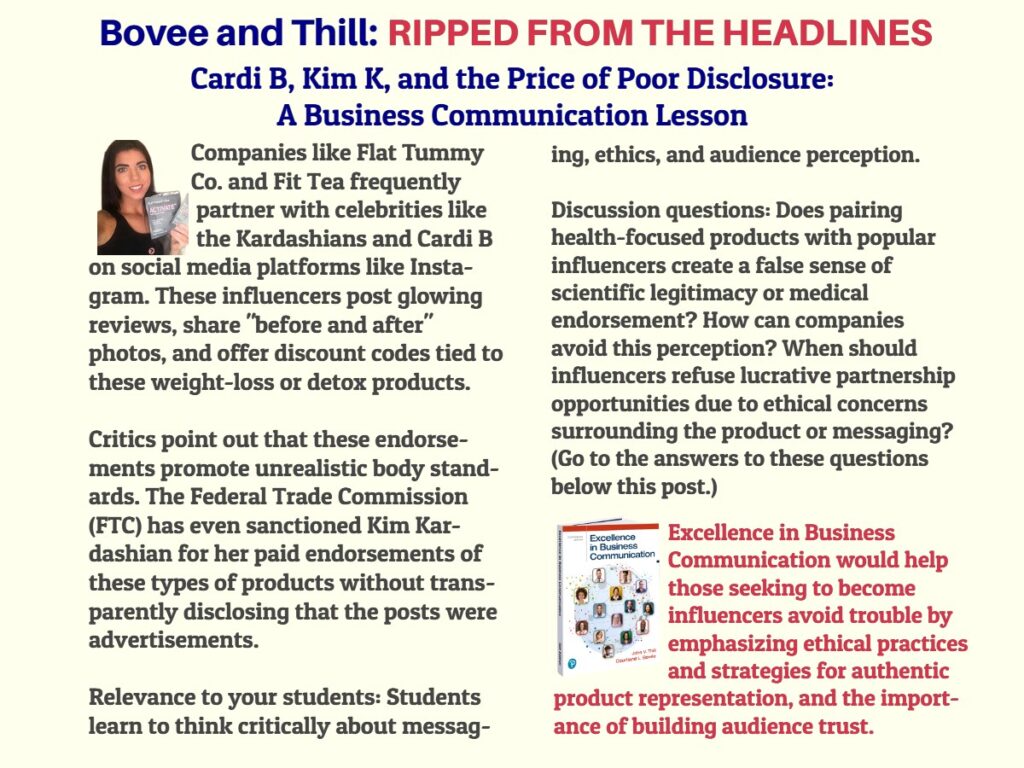 ANSWERS:

 This list has been one of the most popular posts we have ever published. Since we just updated and expanded the list, we thought this would be a great time to repost it.
 This is the fifth post in a new series in which we explore a variety of essential skills for using digital, social, and visual media. We’ll present the information in ways that you can share directly with your students, and we hope this information will enhance your lectures and class discussions.