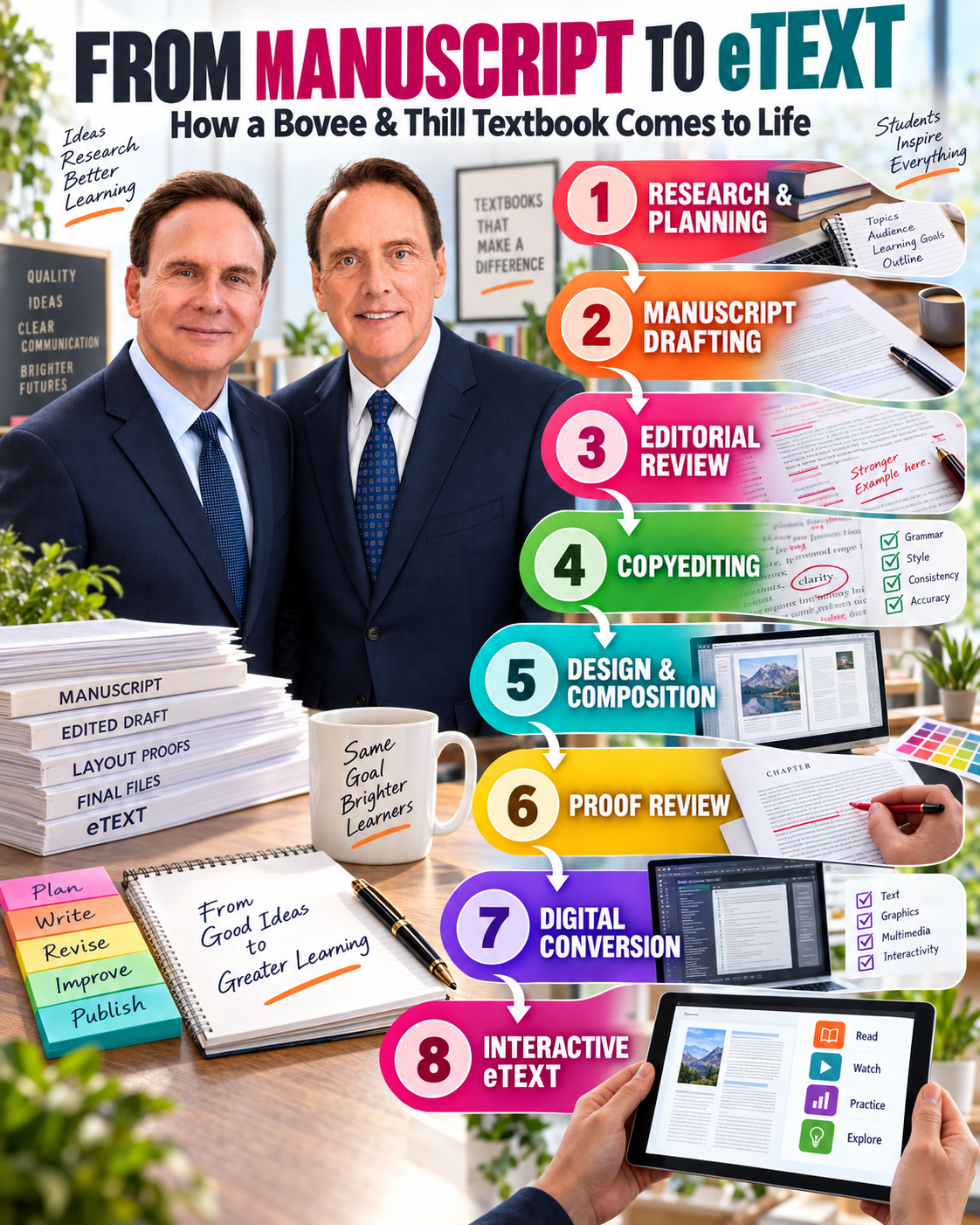
A successful textbook begins with ideas—but ideas alone are not enough. They must be researched, tested, organized, refined, and transformed into an effective learning experience. For Bovee & Thill, every stage of textbook development serves one central purpose: helping students understand important concepts, remember them, and apply them successfully in college, their careers, and their lives.
Among Bovee & Thill’s most significant ideas is NeuroOptimized Learning™, an innovative approach that applies insights from neuroscience and cognitive science to textbook content and instructional design. Soon to be incorporated into all Bovee & Thill textbooks, NeuroOptimized Learning™ is designed around how students process, retain, retrieve, and apply knowledge. It represents the kind of forward-looking innovation that begins as a promising idea and becomes a practical learning advantage for students and instructors.
The textbook-development journey begins with research and planning. Bovee & Thill examine emerging business practices, workplace expectations, technological developments, instructor needs, and the changing ways students learn. This research determines what students need to know, which abilities they need to develop, and how the material can best prepare them for today’s workplace.
Next comes manuscript drafting. Complex subjects must be explained with clarity, accuracy, and relevance. Concepts are connected to realistic examples, contemporary business situations, and practical applications. The objective is not simply to present information but to create a carefully structured learning pathway that helps students move from understanding a concept to using it confidently.
Editorial review adds another level of refinement. Editors examine the manuscript for accuracy, organization, instructional effectiveness, consistency, and relevance. They identify opportunities to clarify explanations, strengthen examples, improve transitions, and make the content even more useful. This collaborative process challenges every chapter to become stronger.
During copyediting, grammar, terminology, style, consistency, and factual details are checked meticulously. Sentences are polished, unnecessary complexity is removed, and the presentation is made as clear and professional as possible. These refinements may appear subtle, but collectively they make the reading experience smoother and more accessible.
Design and composition then transform the edited manuscript into a visual learning environment. Typography, page architecture, photographs, illustrations, tables, charts, and other visual elements work together to guide attention and reinforce meaning. Effective design is not merely decoration; it helps students navigate the material, understand relationships, and recognize essential information.
Proof review provides another opportunity to examine every element in context. Text, visuals, captions, headings, references, and page layouts are reviewed for accuracy and effectiveness. Adjustments are made wherever something could be clearer, more consistent, or easier to use.
Digital conversion extends the textbook beyond the printed page. Content is adapted for an interactive environment in which students can read, watch, practice, explore, and receive feedback. Multimedia resources and learning activities offer additional ways to engage with ideas and strengthen understanding.
The final interactive eText is therefore much more than a digital version of a printed book. It is the product of extensive research, creative thinking, collaboration, and thousands of careful decisions. From NeuroOptimized Learning™ to the smallest editorial refinement, Bovee & Thill’s great ideas share the same goal: creating learning experiences that are clear, relevant, memorable, and powerful.