By John V. Thill and Courtland L. Bovée, authors of Excellence in Business Communication
In the fifteenth edition of Excellence in Business Communication, Thill and Bovée introduce NeuroOptimized Learning™, a comprehensive instructional framework designed to align textbook presentation with how the brain naturally processes, organizes, and retains information. Rooted in decades of convergent research in cognitive psychology, educational neuroscience, and the learning sciences, this approach represents a meaningful departure from traditional textbook design, which has typically relied on narrative exposition with only modest concessions to cognitive accessibility.
Rather than treating pedagogical features as supplemental embellishments, NeuroOptimized Learning builds neuroscientific principles directly into both the feature layer—infographics, neurolearning prompts, and structured visuals—and the text layer itself, which was extensively rewritten to reduce cognitive overload and sharpen conceptual clarity. The result is an instructional system whose design choices are grounded in established research on how human beings learn.

“Make the Connection” prompts invite students to draw on familiar experiences before exploring new business communication concepts.
The first and most foundational pillar of NeuroOptimized Learning is active engagement, grounded in the neuroscience of schema activation. Schemas are organized mental frameworks stored in long-term memory; when new information successfully attaches to an existing schema, it is encoded more deeply and retrieved more reliably. The textbook’s “Make the Connection” neurolearning prompts are explicitly designed to activate these structures before students encounter new material, prompting them to draw on personal experience—for example, reflecting on the dynamics of the best team they have ever been part of before studying organizational communication principles.
This strategy aligns with what cognitive scientists call the generation effect: information that students actively generate or retrieve from memory is encoded more durably than information they passively read. By positioning retrieval at the entry point of each learning sequence, the textbook leverages the brain’s own architecture to prepare students for deeper processing of incoming content.
Central to the framework is the systematic management of cognitive load—the mental effort imposed on working memory during learning. John Sweller’s cognitive load theory established that working memory can hold only a limited number of information elements simultaneously, and that instructional designs which exceed this capacity impair learning by leaving insufficient resources for the construction of meaningful understanding. Subsequent researchers demonstrated that well-structured instructional sequences, clear subheadings, chunked content, and the elimination of redundant information all reduce extraneous cognitive load and direct available mental resources toward germane processing—the effortful thinking that actually builds knowledge.
Excellence in Business Communication operationalizes these findings by rewriting chapters to eliminate redundancy, converting dense paragraphs into bullet lists and structured tables, and in some cases reducing chapter length by as much as 25 percent while simultaneously improving clarity and real-world applicability. The guiding editorial principle—focusing each chapter on the communication decisions students and professionals need to make and avoiding the trap of encyclopedic coverage—reflects a sophisticated understanding of how extraneous detail competes with essential learning.
The same delivery update can appear as a dense paragraph or as a clear decision supported by key details and next steps.
The framework’s second major pillar, visual learning, draws on Allan Paivio’s dual coding theory, which proposes that the human brain encodes and stores information through two functionally independent but interconnected systems—one verbal and one visual—and that engaging both simultaneously produces richer, more retrievable memory representations. Richard Mayer’s subsequent multimedia learning research confirmed that students learn more deeply from words and pictures together than from words alone, and that the spatial and temporal contiguity of text and visuals is itself a design variable with measurable effects on comprehension.
Excellence in Business Communication applies these findings through a carefully curated feature layer of infographics, flowcharts, mind maps, model messages, and quick-reference tables, all positioned in close proximity to the written explanations they accompany. Mousavi, Low, and Sweller further demonstrated that presenting material in both visual and auditory formats concurrently reduces cognitive load and improves problem-solving transfer—a finding that supports the textbook’s multisensory digital components and mobile-accessible resources within its MyLab platform.
Among the most robustly supported findings in the cognitive science of learning is the testing effect, or retrieval practice effect: the act of recalling information from memory strengthens the neural pathways associated with that knowledge far more effectively than passive re-exposure to the same material. Related research on the spacing effect shows that distributing practice across time—rather than massing it in a single session—produces superior long-term retention by allowing the brain time to consolidate memories between learning events. A 2019 neuroimaging study confirmed this mechanism at the neural level, demonstrating that spaced learning increases the fidelity of neural pattern reinstatement during memory retrieval, meaning the brain reconstructs the original learning episode more completely and accurately.
Excellence in Business Communication embeds neurolearning prompts throughout its chapters, including curiosity-generating openers placed before key sections and reflective concept connectors that ask students to synthesize what they have just read with broader communication principles. These prompts function as distributed retrieval events built into the reading experience itself, requiring students to reconstruct and apply knowledge rather than simply proceed through the text as passive readers.
The framework’s treatment of metacognition and motivational relevance reflects another well-established body of evidence from educational neuroscience and learning science. Metacognition—the capacity to monitor, evaluate, and regulate one’s own cognitive processes—has been associated with sustained activation in the prefrontal cortex and anterior cingulate cortex, regions critical for executive function, error detection, and adaptive decision-making. Research syntheses on metacognitive and self-regulated learning approaches have found that explicit strategy instruction can produce substantial academic benefits, with particularly strong effects for students from diverse educational backgrounds.
Equally important is the neuroscience of emotional salience: research by Immordino-Yang and Damasio established that emotion and cognition are neurologically inseparable, and that learners are fundamentally more likely to encode and retain information they perceive as personally meaningful or emotionally relevant. The textbook’s evaluative prompts activate students’ judgment processes, while career-focused features directly link academic content to high-stakes professional goals—leveraging the brain’s tendency to prioritize for retention information it deems important for future success.
The sixth pillar of NeuroOptimized Learning—sleep and study optimization coaching—addresses what neuroscientists consider one of the most powerful and most frequently overlooked determinants of long-term memory consolidation. Matthew Walker’s research demonstrated that sleep plays an indispensable role in transferring newly encoded information from the hippocampus, where short-term memories are initially stored, to the neocortex, where stable long-term memories reside. Born and Wilhelm further showed that slow-wave and REM sleep stages each contribute to different types of memory consolidation, making sleep timing and duration directly relevant to academic performance. By integrating evidence-based guidance on sleep schedules, study timing, and spaced-practice strategies into its student-facing resources, Excellence in Business Communication addresses a dimension of learning that most textbooks entirely ignore.
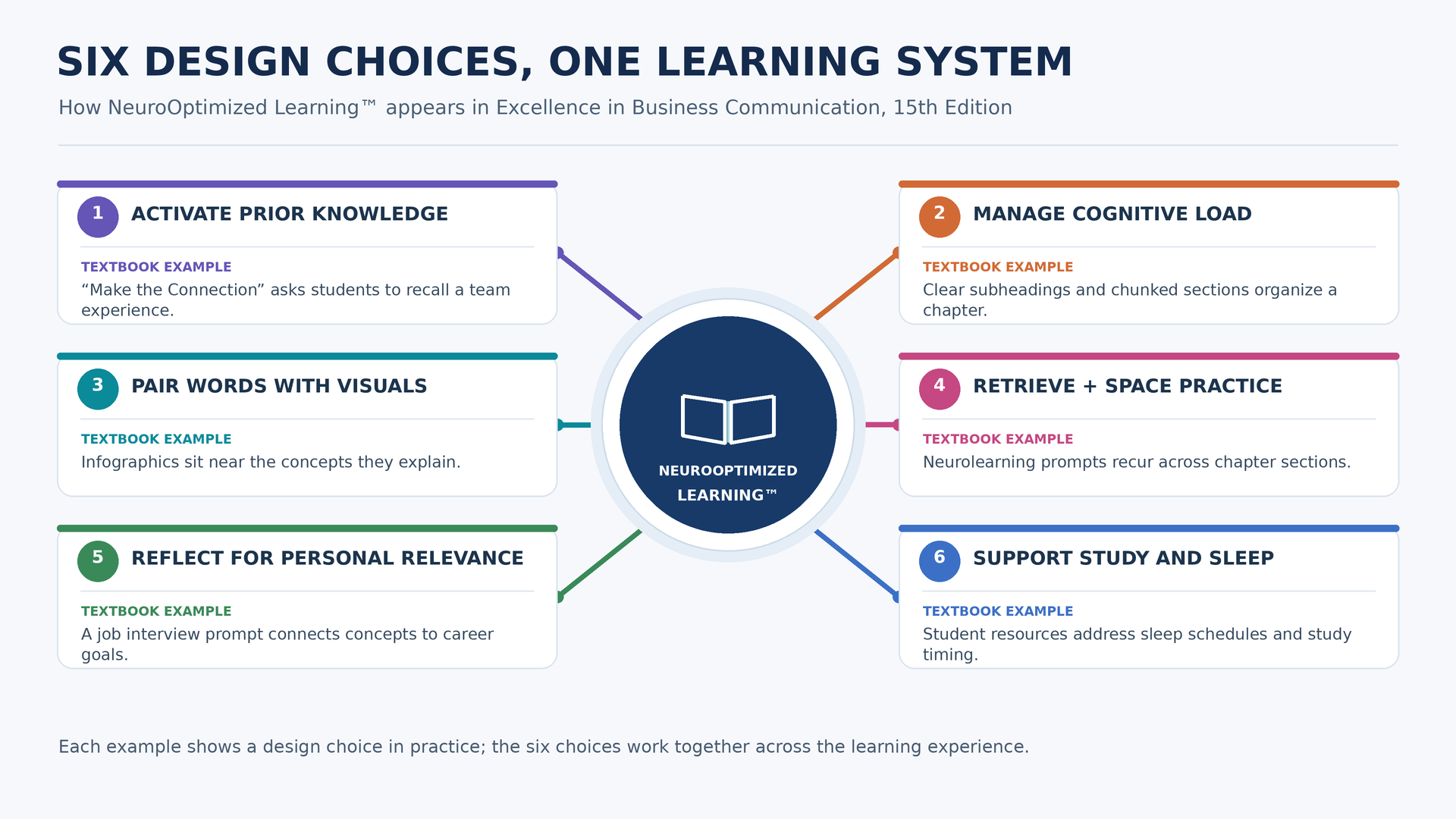
NeuroOptimized Learning™ connects six instructional design choices to concrete features in Excellence in Business Communication, 15th Edition.
Taken together, the six pillars of NeuroOptimized Learning constitute a coherent, science-driven instructional architecture—one that succeeds not because it adds surface-level pedagogical features, but because each design decision is informed by validated research on how the human brain encodes, consolidates, and retrieves knowledge. For students, the result is a learning experience that is more comprehensible, more memorable, and more transferable; for instructors, these benefits are built directly into the structure of the text, requiring no additional pedagogical effort to realize.
Notes
- John V. Thill and Courtland L. Bovée, Excellence in Business Communication, 15th ed. (Hoboken, NJ: Pearson, 2028 copyright; publication scheduled for January 2027), preface, “The Science Behind NeuroOptimized Learning.”
- Thill and Bovée, Excellence in Business Communication, preface.
- Thill and Bovée, Excellence in Business Communication, preface.
- John Sweller, “Cognitive Load Theory, Learning Difficulty, and Instructional Design,” Learning and Instruction 4, no. 4 (1994): 295–312.
- Fred Paas, Alexander Renkl, and John Sweller, “Cognitive Load Theory and Instructional Design: Recent Developments,” Educational Psychologist 38, no. 1 (2003): 1–4.
- Thill and Bovée, Excellence in Business Communication, preface.
- Allan Paivio, Imagery and Verbal Processes (New York: Holt, Rinehart and Winston, 1971).
- Richard E. Mayer, Multimedia Learning, 2nd ed. (Cambridge: Cambridge University Press, 2009), 31–50.
- Sohail Mousavi, Renae Low, and John Sweller, “Reducing Cognitive Load by Mixing Auditory and Visual Presentation Modes,” Journal of Educational Psychology 87, no. 2 (1995): 319–334.
- Henry L. Roediger III and Jeffrey D. Karpicke, “Test-Enhanced Learning: Taking Memory Tests Improves Long-Term Retention,” Psychological Science 17, no. 3 (2006): 249–255.
- Nate Kornell and Robert A. Bjork, “Learning Concepts and Categories: Is Spacing the ‘Enemy’ of Induction?” Psychological Science 19, no. 6 (2008): 585–592.
- Yifan Cai et al., “Spaced Learning Enhances Episodic Memory by Increasing Neural Pattern Reinstatement,” Cerebral Cortex 29, no. 9 (2019): 3792–3805.
- Thill and Bovée, Excellence in Business Communication, preface.
- Anaïs Llorens et al., “Metacognition: Ideas and Insights from Neuro- and Educational Sciences,” npj Science of Learning 6, no. 13 (2021): 1–12. https://doi.org/10.1038/s41539-021-00089-5.
- Education Endowment Foundation, “Metacognition and Self-Regulation,” Teaching and Learning Toolkit, updated May 20, 2025, https://educationendowmentfoundation.org.uk/education-evidence/teaching-learning-toolkit/metacognition-and-self-regulation.
- Mary Helen Immordino-Yang and Antonio Damasio, “We Feel, Therefore We Learn: The Relevance of Affective and Social Neuroscience to Education,” Mind, Brain, and Education 1, no. 1 (2007): 3–10.
- Thill and Bovée, Excellence in Business Communication, preface.
- Matthew P. Walker, Why We Sleep: Unlocking the Power of Sleep and Dreams (New York: Scribner, 2017), 155–172.
- Jan Born and Ines Wilhelm, “System Consolidation of Memory During Sleep,” Psychological Research 76, no. 2 (2012): 192–203.
- Thill and Bovée, Excellence in Business Communication, preface.