The Invisible Influences in Teaching Business Communication

college instructor pondering invisible influences in her office

Navigating the unseen: Just like this thoughtful educator pondering invisible influences, business communication instructors must recognize and adapt to the hidden forces shaping today's learning environment. Whether it's shifting workplace norms, evolving student expectations, or technological disruptions, understanding these invisible elements is key to crafting dynamic, responsive, and effective teaching strategies

The Invisible Influences in Teaching Business Communication: Uncovering Hidden Forces


In the realm of higher education, teaching business communication at the college level involves navigating a complex landscape of unseen forces and indirect influences. These hidden factors shape student learning, engagement, and overall success in ways that may not be immediately apparent in the day-to-day classroom environment. However, their impact on how effectively students develop essential communication skills is significant. 


By recognizing and addressing these invisible influences, educators can make more informed teaching decisions, improve student outcomes, and create a more dynamic, responsive classroom environment that better prepares students for the realities of modern business communication.


1. Recognizing Hidden Influences in Teaching Business Communication:


The landscape of business communication is constantly evolving, driven by a multitude of factors that may not always be directly addressed in traditional teaching materials. Recognizing these hidden influences is crucial for educators to stay ahead of the curve and provide relevant, effective instruction. One of the most significant unseen forces is the rapidly changing workplace communication norms. The rise of remote work, collaborative digital tools, and shifting workplace hierarchies have transformed how businesses communicate. For instance, the growing reliance on virtual meetings and team-based communication platforms like Slack or Microsoft Teams has fundamentally altered how teams collaborate across distances. This shift necessitates a reevaluation of what skills students need to succeed in future business communication environments.


Cultural and social shifts among students also play a crucial role in shaping communication styles and preferences. Today's students, particularly those from Generation Z, are influenced by broader social dynamics that emphasize values such as authenticity, transparency, and inclusivity. This trend extends to communication styles, with many younger professionals preferring more direct, less hierarchical forms of interaction. Acknowledging these cultural shifts can help instructors design assignments and class activities that resonate with students and prepare them for modern workplace communication expectations.


Technological disruptions in both education and business communication are another invisible force shaping how students learn and communicate. AI-powered writing assistants, chatbots, and automated email tools are becoming commonplace in professional settings, yet they may not always be integrated into traditional business communication curricula. Understanding how these tools influence communication in the workplace is crucial for educators to help students navigate the balance between relying on technology and honing their own communication skills.


Institutional and regulatory factors, such as changes in educational policy or shifts in institutional priorities, can indirectly influence how business communication courses are taught. For instance, the growing emphasis on outcomes-based education has led many institutions to revamp their curriculum design processes. These unseen forces may lead to shifts in course structure, learning objectives, and how student success is measured, requiring educators to align their teaching strategies with broader educational goals.


2. The Power of Recognizing Unseen Forces:


Understanding and leveraging these hidden influences can significantly enhance the effectiveness of business communication instruction. By anticipating changes in workplace communication norms, educators can better prepare students for the future of work. This might involve emphasizing skills like clear written communication for emails, concise virtual presentation techniques, or effective management of remote teams.


Tailoring teaching methods to align with cultural dynamics can lead to more effective engagement and learning outcomes. For example, incorporating discussions on diversity, equity, and inclusion (DEI) in business communication or creating opportunities for collaborative learning can resonate with students' values and increase their engagement with the material. A study by the National Association of Colleges and Employers found that 79% of Gen Z job seekers consider an employer's commitment to diversity and inclusion when deciding where to work, underscoring the importance of addressing these themes in business communication courses.


Leveraging technology to enhance learning can also yield significant benefits. Integrating communication technologies like video conferencing or collaborative document editing into classroom assignments can simulate real-world business scenarios. Additionally, teaching students how to critically evaluate the use of AI tools for communication, such as knowing when to rely on a grammar checker versus their own judgment, can set them up for success in an increasingly tech-driven workplace.


Aligning with institutional priorities ensures that business communication courses remain relevant and valuable within the larger educational framework. For instance, if an institution emphasizes skills-based learning, educators can design assignments that focus on real-world applications, such as mock presentations or client communications. This alignment not only enhances student learning but also demonstrates the course's value to administrators and stakeholders.


3. How to Identify and Leverage Unseen Forces in Teaching Business Communication:


To effectively identify and leverage these hidden influences, educators can employ several strategies. Staying attuned to industry trends is crucial. This can involve attending industry conferences, reading business journals, and engaging with professional networks to gain insights into evolving communication practices. The World Economic Forum's Future of Jobs Report, for instance, consistently highlights the growing importance of digital and emotional intelligence skills in the workplace, providing valuable guidance for curriculum development.


Engaging in cross-disciplinary learning can also yield valuable insights. Understanding how fields like technology, psychology, or sociology influence communication dynamics can help educators design more comprehensive and insightful lessons. For example, insights from behavioral economics on decision-making processes can inform lessons on persuasive communication techniques.


Monitoring student preferences and behaviors provides a direct window into the evolving communication landscape. Surveys, class discussions, and informal feedback can reveal valuable information about how students perceive communication in a business context and what skills they believe are most important for their future careers. A study by the National Association of Colleges and Employers found that verbal communication skills are consistently ranked as the most important attribute by employers, highlighting the need to focus on these skills in business communication courses.


Consulting with industry experts can provide invaluable insights into the hidden forces shaping business communication. Guest lectures, partnerships with businesses, or informal conversations with industry professionals can reveal emerging trends and expectations that may not yet be widely recognized. For instance, a 2023 LinkedIn Global Talent Trends report highlighted the growing importance of adaptability and resilience in the workplace, skills that are closely tied to effective communication.


4. Putting It Into Practice:


Translating these insights into effective teaching practices is the final step in leveraging unseen forces in business communication education. Adapting assignments to reflect real-world changes is crucial. For example, creating projects that require students to craft emails or presentations using the latest collaboration tools or address real-world business challenges, such as managing virtual teams, can prepare students for the demands of the modern workplace.


student giving a presentation in class

In a business communication course, students hone their skills by delivering presentations that incorporate real-world business challenges and the latest collaboration tools, equipping them for the demands of today’s dynamic workplace.

Creating opportunities for reflective learning can deepen students' understanding of how hidden forces influence their own communication practices. Assignments that ask students to compare traditional business communication formats with modern equivalents, or to analyze the effectiveness of different communication strategies in various cultural contexts, can foster critical thinking about the factors shaping communication in today's business environment.
Incorporating regular feedback loops between students, educators, and industry professionals can ensure that course content remains relevant and responsive to changing needs. This might involve regular course evaluations, industry advisory boards, or alumni surveys to gather insights on emerging trends and skills gaps.


Embracing the Invisible: Shaping the Future of Business Communication Education


The landscape of business communication is shaped by a myriad of unseen forces and indirect influences, from changing workplace norms to evolving student preferences and technological advancements. By recognizing and responding to these hidden factors, educators can create more dynamic, relevant, and effective business communication courses that truly prepare students for long-term success in the modern business world.


The ability to uncover and leverage these invisible influences enables educators to make more informed decisions, foster greater student engagement, and ultimately enhance the learning experience. Whether it's staying attuned to technological advancements, understanding cultural dynamics, or aligning with institutional goals, the key lies in remaining flexible, curious, and responsive to the ever-changing landscape of business communication.As we move forward, the challenge for educators will be to continually adapt their teaching strategies to address these unseen forces, ensuring that business communication education remains at the forefront of preparing students for the complexities and opportunities of the modern workplace. By embracing this challenge, we can create a new generation of business communicators who are not only skilled in traditional practices but also adept at navigating the invisible currents that shape our professional interactions.


How Business Communication Today Helps Instructors Navigate Hidden Influences in Business Communication
 

Business Communication Today is an essential resource for business communication instructors, especially when considering the insights from The Invisible Influences in Teaching Business Communication: Uncovering Hidden Forces. This textbook equips educators with the tools to address the often-unseen factors that shape student learning, engagement, and communication effectiveness in the modern workplace.
 

The article highlights the importance of recognizing hidden influences—such as shifting workplace norms, evolving student expectations, and technological advancements—that impact how students develop business communication skills. Business Communication Today directly responds to these challenges by incorporating real-world case studies, workplace-relevant activities, and the latest digital communication tools, ensuring that students are well-prepared for today’s dynamic business environments.
 

For example, as remote work and virtual collaboration become standard, effective business communication now requires skills beyond traditional frameworks. The textbook emphasizes virtual presentation strategies, digital collaboration techniques, and professional email communication, ensuring students can confidently navigate hybrid and remote workplaces.
 

Additionally, Business Communication Today acknowledges the cultural shifts among Generation Z students, who prioritize transparency, authenticity, and inclusivity in professional interactions. The textbook includes assignments and discussions that encourage students to develop communication strategies that align with these values, making them more effective in diverse and rapidly evolving business environments.
 

Finally, the book’s robust instructor support, including customizable digital learning tools and adaptive assessments, allows educators to tailor lessons to meet institutional goals and student needs. By addressing these hidden influences, Business Communication Today helps instructors create a responsive, inclusive, and effective learning experience that prepares students for the real-world challenges of business communication.
 

Preview of Part IV: Chapters 10-12, Business Communication Today, 16th Edition

Chapters 10-12 focus on crafting routine, negative, and persuasive messages, integrating AI tools to enhance clarity, empathy, and impact.


Part IV of Business Communication Today, 16th Edition, focuses on mastering the art of crafting routine, negative, and persuasive messages, blending timeless communication strategies with cutting-edge applications of artificial intelligence (AI). This section prepares students to navigate real-world business scenarios effectively while leveraging AI tools to enhance clarity, empathy, and engagement.


Chapter 10: Writing Routine and Positive Messages  


This chapter introduces strategies for creating clear, concise, and respectful routine communications, such as requests, replies, and goodwill messages. AI’s role is highlighted in streamlining message drafting, proofreading, and optimizing tone. Students learn to use AI tools to generate professional, audience-centered content efficiently. Practical examples and exercises demonstrate how AI-driven suggestions for language and structure enhance productivity and communication quality, making this chapter a seamless integration of traditional skills with modern technology.


Chapter 11: Writing Negative Messages  


The challenges of delivering unwelcome news with tact and professionalism are addressed in this chapter. Students learn to balance empathy and clarity, ensuring messages maintain relationships while achieving their objectives. AI-powered tools are emphasized as aids in tone analysis, helping students craft messages that are sensitive yet assertive. Case studies illustrate how AI can refine language to minimize emotional impact and ensure constructive communication. Instructors benefit from tools like MyLab to create customized lessons that engage students in developing these vital skills.


Chapter 12: Writing Persuasive Messages  


This chapter teaches students how to create compelling persuasive messages, from internal proposals to marketing communications. AI’s transformative impact is explored through tools that analyze audience data, enhance message personalization, and test the effectiveness of different appeals. Students gain insights into using AI for crafting targeted, impactful content. Exercises and examples guide them in combining human creativity with AI precision to achieve persuasive success.


Chapters 10-12 of Business Communication Today are exceptionally easy to teach from, offering clear frameworks for writing routine, negative, and persuasive messages. Each chapter includes practical examples, step-by-step guidance, and real-world case studies that connect theory to practice. The integration of AI tools ensures relevance by demonstrating how technology enhances message effectiveness and efficiency. MyLab further supports instructors with interactive resources, customizable assessments, and engaging activities that simplify lesson planning and improve student comprehension. Together, the text and MyLab provide a comprehensive, adaptable teaching platform, empowering students to master essential communication skills for modern business.


The Multi-Audience Problem: Why “Cereal for Dinner” Became a Crisis Communication Case Study

Image symbolizing a disconnect between executive messaging and consumer sentiment during an inflationary cost-of-living crisis.

This representative image visualizes the communication disconnect between corporate and consumer perspectives in the Kellogg's case. Images are illustrative and do not depict actual persons mentioned in this case study.


In early 2024, WK Kellogg Co—custodian of one of the most recognizable food brands in the world—found itself engulfed in backlash after comments made by CEO Gary Pilnick during a televised interview. The intent was clear: reassure investors by highlighting the company’s value proposition during a period of inflation. The result was the opposite.
 

The message landed—but not the way leadership expected.


The Interview That Sparked the Backlash

Pilnick appeared on CNBC’s Squawk on the Street to discuss company performance amid rising grocery prices. As the interviewer raised concerns about household food affordability, Pilnick pivoted to a familiar marketing narrative: cereal as a cost-effective option.
 

“The cereal category has always been quite affordable,” he explained, describing cereal as “a great destination when consumers are under pressure.”
 

He then introduced a specific campaign idea—suggesting that families consider “cereal for dinner” as a way to manage costs.
 

When the host pressed gently—asking whether that message might land poorly with families struggling to afford nutritious meals—Pilnick doubled down, insisting that the idea was “landing really well with the consumer.”
 

It wasn’t.
 

Within hours, short clips of the exchange spread across TikTok, X, and Instagram. The reaction was swift and harsh. Critics framed the comment as emblematic of corporate indifference: a highly compensated CEO advising families facing “heat-or-eat” decisions to lower their expectations rather than addressing structural affordability.
 

What had been positioned as practical advice was received as condescension.


What Went Wrong—and Why It Was Predictable

This was not a verbal slip or media ambush. It was a systemic communication failure, rooted in misaligned audience awareness and emotional context.
 

Audience Misalignment

Pilnick spoke as though his primary—and only—audience was Wall Street analysts. In reality, televised interviews in the social media era have simultaneous audiences:

  • Investors evaluating margins and growth
  • Consumers interpreting values and intent
  • Employees watching how leadership speaks about customers
     

The message was optimized for the first group and alienated the other two.
 

The Say–Do Gap

For decades, Kellogg’s branding emphasized family wellness, nourishment, and care. The suggestion that families simply downgrade dinner expectations created a visible gap between brand narrative and executive rhetoric—a credibility fracture audiences detect instantly.
 

Emotional Intelligence Failure

Technically, Pilnick’s cost-per-serving logic was accurate. Communicatively, it failed. In high-stress economic conditions, people listen less for arithmetic and more for respect, empathy, and acknowledgment of hardship.
 

The inferred message—not the literal one—dominated public reaction: “We see your struggle, and our solution is for you to accept less.”


The Aftermath

The company was forced into reactive mode. Calls for boycotts circulated. Commentary framed the moment as emblematic of corporate “greedflation.” WK Kellogg Co issued clarifications, but the reputational damage had already occurred.
 

The lesson was clear—and costly: In modern business communication, every operational statement is also a moral signal.


Where Business Communication Education Makes the Difference

What makes this episode so instructive is not its uniqueness, but its familiarity. Similar moments unfold every day in earnings calls, investor briefings, executive interviews, and internal town halls. And in most cases, the damage is not caused by flawed strategy or bad data—it is caused by preventable communication failures.
 

The skills that would have changed the outcome in this case were not technical. They were communicative:

  • Audience analysis — anticipating multiple, simultaneous audiences rather than assuming a single listener

  • Visual and message hierarchy — deciding what must be emphasized, softened, or contextualized

  • Medium-aware design — understanding how televised interviews and social media clips reshape meaning

  • Strategic storytelling — framing facts within narratives that signal empathy, responsibility, and purpose

  • Professional presence in virtual and broadcast settings — recognizing that tone, pacing, and phrasing are interpreted as values
     

These are precisely the competencies emphasized throughout Business Communication Today, 16th Edition.
 

Rather than treating presentations and interviews as a final step—something that happens after the analysis—the text frames communication as integral to decision-making itself. Students learn that clarity is not simplification; it is respect for the audience’s time, context, and cognitive load.
 

The book’s guidance on visual and oral communication helps future professionals distinguish between messages designed for reading and messages designed for listening and viewing—a distinction routinely ignored in high-stakes corporate settings. Slides that overwhelm, phrases that oversimplify, or metaphors that misfire often derail otherwise sound strategies.
 

Equally important, the text’s coverage of digital and virtual communication addresses the realities of modern executive visibility. Platforms such as CNBC, Zoom, Teams, and social media are not neutral channels; they compress nuance, amplify emotion, and reward sound bites over explanations. Students learn to adapt messages to these constraints without sacrificing professionalism or ethical judgment.
 

Perhaps most importantly, Business Communication Today reinforces a critical mindset shift:
 

The purpose of business communication is not to display intelligence—it is to enable action.
 

Had that principle guided the interview preparation in this case, leadership might have focused less on what consumers should do and more on what the company was doing—absorbing costs, protecting value, or supporting households during economic stress.
 

The strategy itself did not need to change. The communication architecture did.


Using This Story as a Teachable Case
 

Use this story as a teachable case with your students. It works particularly well in units on audience analysis, executive communication, ethics, crisis response, and professional judgment.
 

Have students read the case first without discussion. Then pose the questions below.


Discussion Questions — with Model Answers

1. Why did a technically accurate statement trigger a public relations crisis?

Model Answer:
Because communication does not occur in a vacuum. In the context of inflation and widespread financial stress, the statement was interpreted emotionally rather than analytically. Accuracy without empathy can feel dismissive. The crisis emerged not from incorrect data, but from misjudged context.


2. Who were the key audiences for this message, and how did their needs differ?

Model Answer:
The primary audience was investors seeking reassurance about demand stability. The secondary audience was the general public, who wanted acknowledgment of hardship and respect. Pilnick failed by optimizing for the first audience while underestimating the reach and sensitivity of the second.


3. How did tone and phrasing shape public perception more than intent?

Model Answer:
Tone communicates values. The phrase “cereal for dinner” suggested sacrifice imposed on consumers rather than support offered by the company. Alternative phrasing could have emphasized what Kellogg’s was doing for families instead of what families should do for Kellogg’s.


4. How does social media amplification change the risks of executive interviews?

Model Answer:
Every live interview is now effectively a global broadcast. Short clips strip away nuance and magnify emotional impact. This raises the stakes for precision, empathy, and foresight. Executives must assume all messages are public, permanent, and remixable.


5. If you were advising the CEO, how would you have reframed the response?

Model Answer:
A stronger response would lead with empathy and shared concern, for example:

“We know families are under real pressure right now, and our responsibility is to make sure our products remain accessible without compromising quality, while we absorb costs where possible.”

This reframing centers the consumer, not the product.


Future-Proofing AI Instruction That Won’t Age Quickly

.Business communication instructor leading a discussion on future-ready AI principles using conceptual frameworks rather than specific technology tools. 
Figure 1. Designing AI instruction that lasts means teaching judgment, ethics, and communication principles—not chasing tools that will soon change.


AI evolves rapidly—but business communication education must be built to endure.
For instructors evaluating AI coverage in today’s textbooks, the central concern is no longer whether AI is included. It is whether that content will remain instructionally valuable as tools, models, and platforms inevitably change.

Generative AI will not stand still. Today’s dominant models will be surpassed. Interfaces will evolve. Capabilities will expand—and sometimes contract. The real differentiator, then, is whether a textbook’s AI content is designed around lasting communication principles rather than fleeting technologies.

That distinction is especially clear in how Business Communication Today, 16th Edition approaches AI integration.


The Real Risk: Tool-Centered AI Instruction

Many AI integrations fail not because they are inaccurate, but because they are too specific.

Content that teaches students:

  • How to use a particular interface

  • Which prompt tricks work “right now”

  • How to optimize output for a single platform

may feel practical in the moment—but it ages quickly and transfers poorly to new contexts.

Business Communication Today, 16th Edition deliberately avoids this trap by embedding AI into the core communication process, not treating it as a standalone technology lesson.


1. Principles Over Platforms: The Foundation That Endures


Close-up of a notebook or tablet on a desk showing hand-drawn diagrams labeled with concepts such as “Judgment,” “Audience,” “Ethics,” and “Verification.” A blurred laptop screen in the background suggests technology without showing any interface. The focus is on thinking, planning, and decision-making rather than execution. 

Figure 1.2 Future-ready AI education starts with principles that remain relevant—long after today’s tools are replaced.

The AI instruction in Business Communication Today, 16th Edition is built on communication fundamentals that predate—and will outlast—any specific AI tool.

Rather than asking:

  • “How do you use this AI tool?”

the text consistently asks:

  • “How does AI change audience analysis?”

  • “Where does professional judgment override automation?”

  • “How do writers retain accountability when AI assists the process?”

Students learn:

  • How prompts function as strategic instructions

  • Why revision and verification remain human responsibilities

  • How credibility, tone, and ethics apply regardless of technology

This principle-first design ensures that when tools change, the learning does not collapse with them.


2. AI Integrated Across Chapters—Not Isolated

A major signal of future-readiness is where AI appears in the curriculum.

In Business Communication Today, 16th Edition, AI is not confined to a single chapter or appendix. Instead, it is woven throughout the text—appearing wherever communication decisions occur:

  • Writing and revising messages

  • Analyzing audiences

  • Managing workplace ethics

  • Collaborating in teams

  • Presenting data and visuals

This reflects how AI actually operates in professional environments: embedded in workflows, not siloed as a special topic.

Because AI is contextualized within enduring communication tasks, instructors can update examples without restructuring the course.


3. Adaptable Frameworks That Absorb Change

Future-ready textbooks rely on flexible instructional frameworks, and Business Communication Today, 16th Edition consistently uses models that can accommodate new AI developments.

Examples include:

  • Human–AI collaboration models

  • Decision frameworks for when to rely on AI versus human expertise

  • Evaluation criteria for AI-generated content

  • Ethical reasoning structures that apply across scenarios

These frameworks allow instructors to introduce new tools—or remove outdated ones—without rewriting assignments or learning objectives.


4. Core Competencies That Transfer to the Workplace

Rather than teaching AI as a shortcut, Business Communication Today, 16th Edition treats it as a professional skillset that requires judgment.

Students develop competencies that remain valuable regardless of tools:

  • Critical evaluation of AI output

  • Strategic prompting and refinement

  • Responsibility for final messages

  • Audience adaptation in AI-assisted communication

  • Ethical reasoning under ambiguity

These skills align with what employers actually expect: not AI fluency alone, but AI-informed communication judgment.


5. Critical Thinking as the Centerpiece

One of the most future-proof aspects of Business Communication Today, 16th Edition is its insistence that AI output must always be questioned.

Students collaboratively evaluating communication drafts, illustrating critical thinking and ethical judgment in AI-assisted business communication.


Figure 1.3 Teaching students how to question, evaluate, and take responsibility for AI-assisted communication builds skills that transfer to any workplace.

Students are taught to:


  • Identify limitations and blind spots

  • Detect hallucinations or overconfidence

  • Compare AI-generated messages with human alternatives

  • Decide when AI use introduces risk rather than value

This positions AI as a collaborator—not an authority—reinforcing habits of mind that remain essential as AI grows more capable.


6. Ethics Designed for the Future, Not Just the Present

Ethical guidance in Business Communication Today, 16th Edition is framed around principles, not policies tied to specific tools.

Students engage with questions such as:

  • Who is accountable for AI-assisted communication?

  • When does efficiency conflict with transparency?

  • How should professionals disclose AI use?

  • Where does automation threaten trust?

Because these ethical discussions are rooted in professional responsibility rather than tool-specific rules, they remain relevant as technologies evolve and organizational norms shift.


7. Author Commitment as a Signal of Longevity

Finally, future-readiness is reflected in authorial intent and revision history.

Business Communication Today, 16th Edition builds on decades of continuous revision, consistently aligning communication instruction with:

  • Workplace realities

  • Employer expectations

  • Technological change

  • Pedagogical research

The decision to integrate AI across every chapter—rather than adding it as a late-stage supplement—signals a long-term commitment to keeping the content aligned with how communication actually works in modern organizations.


Key Questions—Revisited Through Business Communication Today

How do you evaluate whether AI content will stay relevant?
By examining whether AI is embedded in enduring communication processes rather than tied to temporary tools.

What makes AI teaching future-proof?
Teaching students how to think, evaluate, and decide with AI—not just how to generate content.

Should textbooks focus on specific tools or general principles?
Tools can illustrate concepts, but principles must drive the instruction.

How often should AI content be updated?
Conceptual frameworks should remain stable; examples and applications should evolve.


Final Thought: Future-Readiness Is Not an Add-On

AI content ages poorly when it is bolted onto a curriculum.It endures when it is designed into the architecture of communication instruction itself. That is the distinguishing feature of Business Communication Today, 16th Edition: AI is treated not as a passing trend, but as a permanent context in which professional communication—and human judgment—will continue to matter.


Preview of Part VII: Chapters 18-19, Business Communication Today, 16th Edition

Chapters 18-19 focus on building careers, writing résumés, and mastering interviews, emphasizing AI tools for competitive job readiness.


Part VII of Business Communication Today, 16th Edition, focuses on preparing students for successful job searches and interviews in the modern workplace. These chapters combine practical strategies with cutting-edge applications of artificial intelligence (AI), empowering students to stand out in competitive employment markets and adapt to evolving hiring technologies.


Chapter 18: Building Careers and Writing Résumés  


This chapter helps students navigate the complexities of launching and managing their careers, with a strong emphasis on creating impactful résumés. AI is integrated as a transformative tool, showcasing how students can use AI-powered platforms to tailor résumés for applicant tracking systems (ATS) and optimize content for specific roles. Practical exercises guide students through leveraging AI for keyword identification, résumé formatting, and real-time feedback on tone and clarity. Examples of effective résumés provide inspiration and clarity, while MyLab activities allow instructors to reinforce key concepts through hands-on learning.


Chapter 19: Applying and Interviewing for Employment  


Students learn how to navigate every stage of the interview process, from crafting application letters to succeeding in interviews and follow-up communications. AI’s role is emphasized in areas like video interview preparation, where tools provide practice scenarios and evaluate body language, tone, and responses. Students also explore how AI streamlines post-interview follow-ups and helps craft polite, professional messages. The chapter addresses current trends in AI-driven recruiting, ensuring students understand and adapt to technologies like chatbots, ATS, and virtual interview platforms.


Part VII equips instructors with a future-focused framework to teach essential career-building skills while integrating modern AI tools. This section ensures students not only develop the confidence and skills to excel in their job searches but also gain a competitive edge in leveraging AI technologies effectively. With its blend of foundational strategies and innovative tools, Business Communication Today is the ultimate guide for teaching career readiness.


Chapters 18-19 of Business Communication Today are exceptionally easy to teach from due to their practical guidance and integration of AI tools. Each chapter includes clear steps for writing résumés, preparing for interviews, and navigating modern hiring technologies, ensuring relevance for today’s students. AI-focused content demonstrates tools for tailoring résumés, practicing interviews, and crafting follow-up messages, making complex tasks approachable and efficient. MyLab enhances instruction with interactive modules, personalized assessments, and instructor resources that streamline course planning and engage students. Together, the text and MyLab provide a comprehensive, future-ready platform for teaching career readiness and professional communication.


The AI Advantage: Elevating Teaching Quality and Productivity in Business Communication

Elevating Teaching Quality and Productivity

AI is revolutionizing business communication education by helping instructors automate tasks, personalize learning, and improve teaching quality and productivity.

Instructors of business communication are increasingly turning to artificial intelligence (AI) to transform how they teach, engage with students, and manage workloads. AI tools are enabling educators to streamline routine tasks, create personalized learning experiences, and deliver higher-quality instruction. In a world where technology is rapidly reshaping education, AI is emerging as a powerful partner to enhance both productivity and teaching outcomes.


Streamlining Administrative Tasks


Business communication instructors often face time-consuming administrative work, such as grading assignments, tracking participation, and managing communication. AI-powered tools are alleviating these burdens:


Automated Grading: Platforms like MyLab for Business Communication by Pearson provide AI-driven grading solutions, delivering instant, consistent feedback on student assignments. This reduces manual grading time and allows instructors to focus on higher-level teaching priorities.


Attendance and Participation Tracking: MyLab for Business Communication by Pearson, along with AI-enabled LMS systems, streamlines tracking attendance and participation, ensuring accurate reporting with minimal effort.


Email Management: AI tools like Grammarly and ChatGPT assist instructors in drafting emails, announcements, and updates efficiently without compromising tone or professionalism.


By automating routine processes, instructors gain valuable time to engage with students more meaningfully and develop innovative teaching strategies.


Enhancing Lesson Planning and Content Creation


AI-powered content generation tools are revolutionizing how instructors design course materials. Business communication educators are harnessing AI to:


Develop Engaging Exercises: Tools like ChatGPT and Perplexity enable instructors to create realistic scenarios, case studies, and role-play activities tailored to professional communication contexts.


Visualize Complex Concepts: Platforms like Canva and Visme leverage AI to help instructors develop visually appealing infographics, presentations, and videos to explain concepts like audience analysis or persuasive communication.


Create Adaptive Learning Modules: MyLab for Business Communication by Pearson provides adaptive learning experiences, using AI to adjust content delivery based on student performance. This ensures learners receive personalized support to improve their skills effectively.


Enhancing Business Communication Education with MyLab


MyLab for Business Communication by Pearson is specifically designed to provide students with the tools they need for success. By integrating interactive, adaptive, and data-driven features, MyLab enhances both learning outcomes and teaching efficiency:


Identifying and Supporting Struggling Learners: MyLab collects detailed data on student performance in formative assessments and quizzes, helping instructors pinpoint comprehension gaps early. This enables timely interventions, ensuring struggling learners receive the support they need before falling behind.


Interactive Simulations and Decision-Making Activities: MyLab includes simulations that connect theoretical concepts to real-world business scenarios. These activities foster practical problem-solving and decision-making skills, preparing students for professional challenges.


Visual and Multimedia Learning: With interactive modules, multimedia content, and visual aids, MyLab caters to diverse learning styles. Visual learners, in particular, benefit from dynamic presentations that make abstract concepts more concrete and easier to retain.


Immediate Feedback: MyLab offers instant feedback on quizzes, homework, and assessments. This real-time feedback loop helps students identify misunderstandings and correct them while the material is still fresh, supporting continuous learning and reinforcement.


Practice Assessments and Chapter Warm-Ups: MyLab holds students accountable for mastering key concepts before class. Through warm-up exercises and practice quizzes, students arrive prepared for discussions and activities, making in-class time more productive.


Personalizing the Learning Experience


One of AI's most significant contributions to education is its ability to personalize learning. Instructors can use AI tools to identify individual student needs and provide tailored feedback:


Real-Time Feedback: AI tools like Grammarly and WriteLab analyze students' writing in real time, highlighting grammar issues, clarity gaps, and tone inconsistencies.


Skill Assessments: MyLab for Business Communication provides detailed performance insights, enabling instructors to identify areas where students struggle and assign targeted exercises to strengthen those skills.


Customized Learning Paths: MyLab's adaptive learning features recommend specific resources, exercises, or tutorials based on students' performance, ensuring no learner is left behind.


By leveraging AI for personalization, instructors can support individual student growth while maintaining scalability in large classes.


Improving Communication and Collaboration Skills


AI tools are also being used to enhance students' communication capabilities. For example:


AI-Powered Presentation Coaching: Tools like Microsoft Speaker Coach analyze students' speech patterns, pacing, and filler words, offering constructive feedback to improve delivery.


Collaboration Simulations: Platforms like MURAL, Miro, and MyLab facilitate virtual team communication and decision-making exercises, preparing students for digital-first workplaces.


Chatbots for Immediate Assistance: AI chatbots integrated into LMS systems provide students with 24/7 support on frequently asked questions, improving accessibility and reducing instructors' workload.


By integrating these tools, instructors equip students with practical skills to thrive in modern business environments.


Supporting Research and Critical Thinking


AI can also foster critical thinking by helping students analyze and interpret information effectively:


AI-Assisted Research: Tools like Elicit and Research Rabbit streamline literature reviews, allowing students to identify credible sources and synthesize findings efficiently.


Debate Simulations: Instructors use AI platforms to generate opposing arguments on ethical dilemmas, encouraging students to practice persuasive communication and critical analysis.


Bias Identification: AI tools teach students to identify and address biases in business communication, ensuring their messages are inclusive and ethical.


Instructors who integrate AI-driven activities not only prepare students for the professional world but also sharpen their analytical and ethical decision-making skills.


Preparing for the Future of Work


Harnessing AI in business communication courses bridges the gap between classroom learning and workplace readiness. By exposing students to real-world applications of AI, instructors demonstrate how these tools can improve:


Efficiency in Business Writing: Students learn to use tools like GrammarlyGO and Jasper to draft professional emails, reports, and presentations quickly and effectively.


Data-Driven Decision-Making: Platforms like Tableau or AI-infused Excel teach students to analyze communication data, such as customer feedback or survey results, to inform strategies.


Ethical AI Usage: Instructors guide students in understanding the importance of transparency, accountability, and ethical considerations when relying on AI for communication tasks.


By teaching students how to harness AI responsibly, instructors help future professionals adapt to an evolving technological landscape.


Key Takeaways


AI is not replacing business communication instructors—it is empowering them. By automating administrative tasks, enhancing content creation, personalizing learning experiences, and improving communication skills, AI allows instructors to focus on what matters most: fostering meaningful connections and delivering impactful education. MyLab for Business Communication by Pearson stands out as a critical tool in this journey, offering adaptive learning, real-time feedback, and interactive simulations that foster deep understanding and professional readiness.


As AI continues to evolve, instructors who embrace its potential will elevate both their teaching quality and students' preparedness for the dynamic future of work.


For business communication educators, AI is more than just a tool—it is a catalyst for innovation, efficiency, and student success.


Business Communication Today  is the ideal text for business communication instructors in this AI era because it seamlessly integrates the timeless principles of effective communication with cutting-edge advancements in artificial intelligence. Designed to address modern workplace challenges, this textbook provides a balanced approach to teaching essential communication skills while embracing the transformative impact of AI on business communication practices.


First, Business Communication Today emphasizes the foundational principles of communication—clarity, conciseness, and audience-centered messaging—that remain vital in any professional setting. These principles form the bedrock of successful communication, even as tools and channels evolve.


What sets Business Communication Today apart in the AI era is its proactive integration of AI concepts. The text equips instructors with strategies to teach students how to use AI tools as collaborators rather than replacements. From leveraging AI for research, drafting messages, and summarizing reports to creating visually impactful presentations, the book empowers students to work smarter and more efficiently. It emphasizes that AI, while powerful, cannot replace human judgment, creativity, and emotional intelligence, underscoring the importance of critical thinking when using AI tools.


Additionally, the text addresses ethical considerations surrounding AI in communication, such as avoiding biases, ensuring transparency, and maintaining credibility. It prepares students to navigate these challenges while upholding professional standards in digital and global communication contexts.


Business Communication Today remains relevant by incorporating real-world case studies from companies like Microsoft, Apple, and Coca-Cola. These examples demonstrate how businesses use AI for persuasive messaging, visual storytelling, and crisis communication, helping students bridge theory and practice.


In an era where AI reshapes every professional’s role, Business Communication Today equips instructors to future-proof their students, ensuring they thrive as thoughtful, tech-savvy communicators.


Neuroscience Meets Business Communication Education


This text integrates research-based principles from neuroscience to enhance learning.  This innovative approach aligns with how the brain learns, retains, and applies information, transforming how business communication is taught and mastered. Imagine students who don’t just memorize concepts but confidently apply them. With engagement soaring and retention deepening, your classroom is where communication skills are mastered for life. Give your students the neuroscience advantage. Join leading colleges and universities already seeing remarkable results with our neuroscience-based approach.


Teaching Digital Media in Business Communication in the AI Era

Written by Courtland Bovee and John Thill


As digital media and artificial intelligence continue to transform business communication, instructors face the crucial task of preparing students for this rapidly evolving landscape. Students must learn not only to master traditional digital channels but also to effectively collaborate with AI tools that can help them write more efficiently, manage information more effectively, and communicate more clearly. 


Today's business communication instruction needs to cover everything from email fundamentals to the strategic use of AI-powered writing assistants, while helping students understand when to leverage technology and when to rely on human skills. This article presents a comprehensive approach to teaching digital media in business communication courses, focusing on essential skills, practical applications, and professional development in an AI-enhanced world. This article is a reflection of the contents of our new, 16th Edition of Business Communication Today by Bovee and Thill (Pearson).


 Understanding the Digital Foundation


The first lesson students need to learn about digital media might seem counterintuitive: despite the dominance of digital channels in modern business, not every message belongs in digital form. While most business communication now occurs through digital channels, students should understand when traditional printed communication might be more appropriate – such as for formal documents, legal requirements, or when a permanent, unchangeable record is needed. This foundational understanding helps students develop the critical thinking skills needed to choose the right channel for each situation.


 Teaching the Art of Digital Composition


Digital media requires mastery of multiple compositional modes, each serving different purposes in business communication. Students need to become proficient in conversational writing for real-time exchanges, crafting constructive comments and critiques, creating orientations that help others navigate complex information, and writing effective summaries that enable quick understanding. They should also learn to develop reference materials, craft compelling narratives, write engaging teasers, compose clear status updates, and create helpful tutorials and FAQs.


 Mastering Key Digital Channels


Email remains a cornerstone of business communication, despite the proliferation of newer channels. Students need to master professional email writing conventions, learn to craft compelling subject lines, and understand how to manage email efficiently. They should also learn to leverage AI tools for email management while maintaining appropriate tone and formality.


Workgroup messaging platforms like Slack and Microsoft Teams require different skills. Students should learn channel organization, professional messaging etiquette, and appropriate use of informal elements like emojis.


Understanding how to balance casual and professional tones in these platforms is crucial for workplace success.


Website content creation demands yet another skill set. Students need to grasp information architecture principles, learn to write for scanability, and understand global audience considerations. They should also become familiar with basic search engine optimization and accessibility requirements.


Wiki development teaches valuable collaborative writing skills. Students should learn how to contribute effectively to shared knowledge bases, manage version control, and maintain quality in collaborative environments.


Podcasting represents an increasingly important channel for business communication. Students need to understand the basics of planning, scripting, and producing audio content, as well as strategies for engaging audiences effectively.


 Developing Essential Professional Skills


Digital etiquette forms a crucial part of professional communication skills. Students must learn to navigate appropriate levels of formality, show cultural sensitivity, and maintain professional boundaries across different digital channels. They need to understand when and how to use elements like emojis, and develop appropriate expectations for response times in different contexts.


The integration of AI tools into business communication presents both opportunities and challenges. Students should learn to use AI effectively while maintaining authentic human connections. This includes understanding how to write effective prompts, evaluate AI outputs, and consider ethical implications of AI use.


Time management in the digital realm requires special attention. Students need strategies for managing multiple channels, organizing information effectively, and protecting their focus in an always-connected environment.


 Practical Implementation in the Classroom


Theory must be balanced with extensive practical application. Classroom activities should include channel selection exercises, email writing workshops, messaging simulations, and collaborative projects. Students should practice creating website content, contributing to wikis, and developing podcasts.


Assessment should focus on real-world applications. This might include creating channel-specific rubrics, conducting peer reviews, and developing professional portfolios. Team projects help students develop collaborative skills while building their digital communication capabilities.


 Building for Long-term Success


The first week of instruction should establish clear expectations for digital communication and introduce core concepts and terminology. However, skill development should continue throughout the course, with progressively more challenging assignments and regular opportunities for practice and feedback.


Success in teaching digital media can be measured through students' ability to select appropriate channels, create effective messages, maintain professional tone, demonstrate technical proficiency, collaborate effectively, and build impressive portfolios.


 Key Takeaways


Teaching digital media in business communication requires a comprehensive approach that combines technical skills with professional judgment. By helping students master various digital channels while developing their professional communication abilities, instructors can prepare them for success in today's digital business environment. The key lies in providing ample opportunities for practical application while maintaining high standards for professional communication across all digital channels.


Remember that the digital landscape continues to evolve, so instructors should stay current with new technologies and trends while helping students develop the adaptability they'll need for long-term success in business communication.


Learning Activities for Teaching Digital Media in Business Communication


Email Skills Development


Basic Email Exercises


 Have students practice writing professional emails to instructors as a real-world application


 Ask students to analyze and improve poor subject lines


 Practice revising informal emails into professional business communications


 Create standard response templates for common business situations


Complex Email Scenarios 


 Write responses to billing disputes or service interruptions


 Compose messages explaining technical features to customers


 Practice team-based email communication for project coordination


 Write sensitive messages about personnel or policy changes


 Create formal business proposals via email


Email Analysis Activities


 Review and critique sample email messages for tone, clarity, and effectiveness


 Identify and correct common email etiquette mistakes


 Analyze email threads for communication breakdowns


 Practice using AI tools to improve email efficiency


Messaging Skills Development


Basic Messaging Exercises


 Practice adapting tone and formality for different business messaging situations


 Create professional responses for customer service scenarios


 Write clear, concise status updates for team projects


 Develop guidelines for emoji use in business contexts


Advanced Messaging Activities


 Roleplay customer support interactions via messaging


 Practice managing team conflicts through messaging platforms


 Create messaging protocols for project teams


 Write messaging templates for common business situations


Website Content Development


Analysis Activities


 Reverse engineer website information architecture


 Evaluate website navigation and user experience


 Analyze content organization and presentation


 Review websites for accessibility compliance


Content Creation Exercises


 Write website content summaries and orientations


 Create FAQ sections for products or services


 Develop user guides and tutorials


 Write content for different target audiences


Collaborative Projects


Team-Based Activities


 Develop communication protocols for virtual teams


 Create wiki content collaboratively


 Plan and execute group presentations


 Write team reports and proposals


Problem-Solving Scenarios


 Address communication breakdowns in virtual teams


 Resolve conflicts in digital environments


 Manage project communications across multiple channels


 Handle sensitive communications professionally


Real-World Applications


Case Studies


 Analyze real business communication situations


 Evaluate communication strategies in actual companies


 Review successful and unsuccessful digital media campaigns


 Study crisis communication responses


Simulation Exercises


 Roleplay customer service scenarios


 Practice team communication in virtual environments


 Simulate project management communications


 Handle crisis communication situations


Assessment Activities


Individual Evaluation


 Create professional email portfolios


 Develop messaging style guides


 Write website content proposals


 Create customer communication templates


Team Evaluation


 Assess group project communications


 Review team collaboration effectiveness


 Evaluate virtual team performance


 Analyze team conflict resolution


AI Integration Exercises


Tool Familiarization


 Practice writing effective AI prompts


 Learn to evaluate AI-generated content


 Experiment with AI writing assistance


 Develop AI collaboration strategies


Practical Applications


 Use AI to improve email efficiency


 Apply AI tools to content creation


 Practice AI-assisted editing


 Develop AI-enhanced communication workflows


Implementation Guidelines


For Instructors


1. Start with basic communication principles before introducing digital tools


2. Provide regular opportunities for practice and feedback


3. Use real-world examples whenever possible


4. Incorporate AI tools thoughtfully and purposefully


5. Balance individual and team activities


For Students


1. Maintain logs of communication activities


2. Document successful strategies


3. Build a portfolio of professional communications


4. Develop personal style guides


5. Practice regular self-assessment


These activities should be integrated progressively throughout the course, building from basic skills to more complex applications. Regular feedback and assessment help ensure skill development and retention.Instructors should adapt these activities based on:


 Course level and duration


 Student experience and skill levels


 Available technology resources


 Industry-specific needs


 Current business communication trends


The key to successful implementation is providing regular opportunities for practice while maintaining high professional standards across all activities.


Note: The guidance provided in this article is based upon the content in the new, 16th Edition of Business Communication Today, by Bovee and Thill (Pearson).


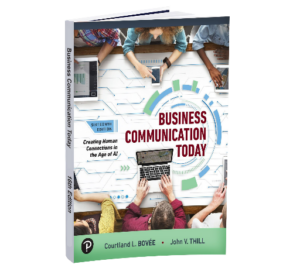
Business communication instructors and their students can step into the future of business communication with the new, groundbreaking 16th edition of Business Communication Today by Courtland Bovee and John Thill—where artificial intelligence meets time-tested principles. For the first time, artificial intelligence (AI) is seamlessly integrated into every chapter, making this the first business communication textbook on the market to offer comprehensive AI coverage.


Neuroscience Meets Business Communication Education


This text integrates research-based principles from neuroscience to enhance learning.  This innovative approach aligns with how the brain learns, retains, and applies information, transforming how business communication is taught and mastered. Imagine students who don’t just memorize concepts but confidently apply them. With engagement soaring and retention deepening, your classroom is where communication skills are mastered for life. Give your students the neuroscience advantage. Join leading colleges and universities already seeing remarkable results with our neuroscience-based approach.


The 12 Most Important Questions Instructors Ask about Teaching Business Communication (and the Answers You Need)


Illustration showing a diverse group of business communication instructors gathered around an interconnected framework, symbolizing recurring teaching concerns such as relevance, engagement, rigor, and preparation for digital and AI-driven communication.


Over the past four decades of working with thousands of business communication instructors, I’ve noticed that their questions—though diverse—tend to circle around 12 core concerns. These questions reveal what truly matters in the classroom: relevance, engagement, rigor, and preparing students for the fast-changing world of digital and AI-driven communication.

Below are the 12 most common questions instructors ask me—and what I tell them.
 

How do I keep the course relevant when technology changes so quickly?

The key is to teach enduring communication principles alongside evolving tools. Business Communication Today, 16th Edition emphasizes timeless skills—clarity, ethics, persuasion, audience awareness—then shows how those same skills apply when using AI tools, social media, and digital channels. When students understand the principles, they can adapt to any technology that comes next.
 

How can I teach AI responsibly without letting it replace students’ writing?

The book’s approach is “AI as collaborator, not ghostwriter.” Students learn to prompt strategically, evaluate AI output for accuracy and tone, and then humanize drafts with empathy and critical thinking. The result: stronger writers who use AI intelligently rather than depend on it blindly.
 

What’s the best way to teach writing fundamentals in the digital age?

Digital tools can assist—but not replace—the fundamentals. The text integrates grammar, clarity, and tone throughout, reinforced by AI-assisted proofreading exercises and hands-on revision practice. Students still learn the craft of writing, but they do so in the context of modern tools they’ll use at work.
 

How do I make the course more engaging for today’s students?

Students respond to relevance and interactivity. Real company cases, data visualization, podcasts, and AI-driven scenarios make the course feel alive. Assignments such as analyzing an influencer’s crisis response or using Canva to create a visual message help students apply communication theory to real situations. Examine this resources page for a wealth of other tools you can use to energize and motivate your students.
 

How can I prepare students for diverse and global workplaces?

Intercultural and inclusive communication are woven throughout. From Dr. Lisa Su at AMD (Chapter 3) to cross-cultural communication frameworks, the course shows how diversity drives innovation—and how empathy, listening, and respect are now essential business skills.
 

How do I teach ethics in an era of misinformation and AI hallucinations?

Ethics can’t live in a single chapter anymore—it has to run through everything students read, write, and create. In Business Communication Today, ethical judgment is woven into every communication task. Students learn how to recognize ethical dilemmas as they arise, use AI tools transparently without crossing into plagiarism, and evaluate AI-generated content for accuracy, bias, privacy, and fairness.

Ethics in Action (Instructor Guide and Student Version) reinforces this integration by giving students repeated, real-world practice making principled communication decisions. Instead of memorizing rules, they develop the habits of ethical thinking needed to navigate misinformation, AI hallucinations, and high-stakes professional communication with confidence and credibility.

Ethics isn’t a separate topic—it’s embedded in every chapter. Students learn how to identify ethical dilemmas, avoid plagiarism with AI tools, and apply transparency in their messaging. They also practice evaluating whether AI-generated content respects privacy, truth, and fairness.
 

How do I balance teaching digital, social, and visual communication?

Think of them as layers of one skill set. Chapters 7–9 walk students through how to choose the right medium, compose for each channel, and design with purpose. They learn not only how to write, but how to see and show messages clearly—crucial for visual learners and digital natives alike.
 

How can I help students overcome presentation anxiety?

Every student can improve, and Chapter 16 shows how. The text emphasizes the neuroscience of confidence—turning nervousness into energy—and includes techniques for virtual, hybrid, and AI-enhanced presentations. Students also study how AI tools like Tome and Beautiful.ai can support, not replace, authentic human delivery.
 

How do I teach students to write negative or persuasive messages tactfully?

Chapters 11 and 12 are designed to help students handle tough communication challenges—from apologies (as illustrated by Apple’s real-world example) to persuasive proposals (as demonstrated by Sephora’s AI-driven storytelling). Students learn to pair empathy with strategy—an essential workplace skill.
 

How can I integrate real-world, job-ready communication practice?

The text connects every communication skill to employability. In the final chapters, students learn résumé writing, LinkedIn optimization, and interview communication strategies—all tied to current employer expectations and ATS systems like Workday. The message is clear: communication is career currency.
 

How do I teach teamwork and collaboration—especially in hybrid settings?

Students engage in collaborative writing, virtual meetings, and problem-solving exercises that mirror modern workplaces. They also learn how to collaborate with AI—treating it as a partner in brainstorming and editing while maintaining ownership of their work.
 

How do I measure learning outcomes effectively?

Each chapter aligns with AACSB, NACE, and institutional learning goals. Built-in assessment tools—chapter objectives, review questions, communication cases, and applied AI tasks—make it easy to verify student progress in both traditional and AI-related competencies.

These twelve questions reflect the heart of every instructor’s mission: preparing students to think critically, communicate ethically, and adapt confidently. The newest edition of Business Communication Today doesn’t just teach students how to write—it teaches them how to connect, lead, and thrive in an AI-driven world where human communication matters more than ever.

Innovation in a Bottle: Coca-Cola’s Digital Evolution

Coca-Cola's Digital Evolution 

As Coca-Cola approaches its 150th anniversary, the beverage giant is proving that age is just a number in the digital age. Under the leadership of Pratik Thakar, its global head of generative AI, the company continues to pioneer new ways of connecting with consumers through technology while staying true to its emotional storytelling roots.


The company's Create Real Magic GenAI platform represents a bold step into the future of brand engagement. By opening up its cherished archive of logos and brand assets to digital artists worldwide, Coca-Cola has transformed its traditional one-way marketing approach into a collaborative creative ecosystem. This initiative does more than just generate fresh content – it democratizes the brand's creative process while helping demystify AI technology for the creative community.


What makes this strategy particularly powerful is how it aligns with Coca-Cola's long-standing mission to evoke feelings of connection and togetherness. The same brand that once taught the world to sing in perfect harmony is now inviting artists to reimagine its iconic imagery through the lens of artificial intelligence. With over 100 million social media followers across various platforms, these digital experiments reach a vast audience while maintaining the emotional resonance that has defined Coca-Cola's marketing for generations.


Perhaps most striking is Thakar's philosophy about brand ownership. Despite the company's careful stewardship of its valuable brand assets, he acknowledges that Coca-Cola ultimately belongs to the people who love it. By embracing this perspective and merging it with cutting-edge technology, Coca-Cola is writing the next chapter in its storied history – one pixel at a time.


NOTE: This is an extract of the chapter-opening vignette that appears exclusively in Chapter 8 of Business Communication Today, 16th Edition, by Bovee and Thill (Pearson).


Business communication instructors and their students can step into the future of business communication with the new, groundbreaking 16th edition of Business Communication Today by Courtland Bovee and John Thill—where artificial intelligence meets time-tested principles. For the first time, artificial intelligence (AI) is seamlessly integrated into every chapter, making this the first business communication textbook on the market to offer comprehensive AI coverage.


Neuroscience Meets Business Communication Education


This text integrates research-based principles from neuroscience to enhance learning.  This innovative approach aligns with how the brain learns, retains, and applies information, transforming how business communication is taught and mastered. Imagine students who don’t just memorize concepts but confidently apply them. With engagement soaring and retention deepening, your classroom is where communication skills are mastered for life. Give your students the neuroscience advantage. Join leading colleges and universities already seeing remarkable results with our neuroscience-based approach.

The Digital Backbone: Why Modern Companies Are Ditching Email for Real-Time Collaboration

Modern Companies Are Ditching EmailIn 2004, three entrepreneurs faced a seemingly simple challenge: they wanted to sell snowboards online. Tobias Lütke, Daniel Weinand, and Scott Lake had the vision, the products, and the determination to launch Snow Devil, their winter sports equipment company. What they lacked was a suitable platform to bring their dream to life. Rather than accepting this limitation, they did what true entrepreneurs do best – they solved the problem themselves.


Lütke, a programmer by trade, led the charge in creating a custom e-commerce solution. As they built and refined their platform, something unexpected happened. The tool they had created to sell snowboards proved to be far more valuable than the snowboards themselves. This revelation led to the birth of Shopify, transforming their modest solution into a global powerhouse that would revolutionize online retail.


As Shopify grew from a small startup into a tech giant, its founders recognized that success wasn't just about the technology – it was about fostering a culture of innovation and knowledge-sharing. They embraced Slack as their digital nervous system, creating an environment where information flows freely across time zones and departments. Smart bots became virtual team members, automating routine tasks and ensuring that crucial information reaches the right people at the right time.


The true test of this digital infrastructure came during the Covid-19 pandemic. While many companies struggled with the sudden shift to remote work, Shopify's culture remained resilient. Their digital-first approach, built on tools like Slack, allowed them to maintain their collaborative spirit even as their workforce dispersed globally. What began as three entrepreneurs' solution to selling snowboards had evolved into a platform that empowers millions of merchants worldwide, proving that sometimes the biggest innovations start with the smallest problems.


NOTE: This is an extract of the chapter-opening vignette that appears exclusively in Chapter 7 of Business Communication Today, 16th Edition, by Bovee and Thill (Pearson).


Business communication instructors and their students can step into the future of business communication with the new, groundbreaking 16th edition of Business Communication Today by Courtland Bovee and John Thill—where artificial intelligence meets time-tested principles. For the first time, artificial intelligence (AI) is seamlessly integrated into every chapter, making this the first business communication textbook on the market to offer comprehensive AI coverage.


Neuroscience Meets Business Communication Education


This text integrates research-based principles from neuroscience to enhance learning.  This innovative approach aligns with how the brain learns, retains, and applies information, transforming how business communication is taught and mastered. Imagine students who don’t just memorize concepts but confidently apply them. With engagement soaring and retention deepening, your classroom is where communication skills are mastered for life. Give your students the neuroscience advantage. Join leading colleges and universities already seeing remarkable results with our neuroscience-based approach.

126