
AI is revolutionizing business communication education by helping instructors automate tasks, personalize learning, and improve teaching quality and productivity.
Instructors of business communication are increasingly turning to artificial intelligence (AI) to transform how they teach, engage with students, and manage workloads. AI tools are enabling educators to streamline routine tasks, create personalized learning experiences, and deliver higher-quality instruction. In a world where technology is rapidly reshaping education, AI is emerging as a powerful partner to enhance both productivity and teaching outcomes.
Streamlining Administrative Tasks
Business communication instructors often face time-consuming administrative work, such as grading assignments, tracking participation, and managing communication. AI-powered tools are alleviating these burdens:
Automated Grading: Platforms like MyLab for Business Communication by Pearson provide AI-driven grading solutions, delivering instant, consistent feedback on student assignments. This reduces manual grading time and allows instructors to focus on higher-level teaching priorities.
Attendance and Participation Tracking: MyLab for Business Communication by Pearson, along with AI-enabled LMS systems, streamlines tracking attendance and participation, ensuring accurate reporting with minimal effort.
Email Management: AI tools like Grammarly and ChatGPT assist instructors in drafting emails, announcements, and updates efficiently without compromising tone or professionalism.
By automating routine processes, instructors gain valuable time to engage with students more meaningfully and develop innovative teaching strategies.
Enhancing Lesson Planning and Content Creation
AI-powered content generation tools are revolutionizing how instructors design course materials. Business communication educators are harnessing AI to:
Develop Engaging Exercises: Tools like ChatGPT and Perplexity enable instructors to create realistic scenarios, case studies, and role-play activities tailored to professional communication contexts.
Visualize Complex Concepts: Platforms like Canva and Visme leverage AI to help instructors develop visually appealing infographics, presentations, and videos to explain concepts like audience analysis or persuasive communication.
Create Adaptive Learning Modules: MyLab for Business Communication by Pearson provides adaptive learning experiences, using AI to adjust content delivery based on student performance. This ensures learners receive personalized support to improve their skills effectively.
Enhancing Business Communication Education with MyLab
MyLab for Business Communication by Pearson is specifically designed to provide students with the tools they need for success. By integrating interactive, adaptive, and data-driven features, MyLab enhances both learning outcomes and teaching efficiency:
Identifying and Supporting Struggling Learners: MyLab collects detailed data on student performance in formative assessments and quizzes, helping instructors pinpoint comprehension gaps early. This enables timely interventions, ensuring struggling learners receive the support they need before falling behind.
Interactive Simulations and Decision-Making Activities: MyLab includes simulations that connect theoretical concepts to real-world business scenarios. These activities foster practical problem-solving and decision-making skills, preparing students for professional challenges.
Visual and Multimedia Learning: With interactive modules, multimedia content, and visual aids, MyLab caters to diverse learning styles. Visual learners, in particular, benefit from dynamic presentations that make abstract concepts more concrete and easier to retain.
Immediate Feedback: MyLab offers instant feedback on quizzes, homework, and assessments. This real-time feedback loop helps students identify misunderstandings and correct them while the material is still fresh, supporting continuous learning and reinforcement.
Practice Assessments and Chapter Warm-Ups: MyLab holds students accountable for mastering key concepts before class. Through warm-up exercises and practice quizzes, students arrive prepared for discussions and activities, making in-class time more productive.
Personalizing the Learning Experience
One of AI's most significant contributions to education is its ability to personalize learning. Instructors can use AI tools to identify individual student needs and provide tailored feedback:
Real-Time Feedback: AI tools like Grammarly and WriteLab analyze students' writing in real time, highlighting grammar issues, clarity gaps, and tone inconsistencies.
Skill Assessments: MyLab for Business Communication provides detailed performance insights, enabling instructors to identify areas where students struggle and assign targeted exercises to strengthen those skills.
Customized Learning Paths: MyLab's adaptive learning features recommend specific resources, exercises, or tutorials based on students' performance, ensuring no learner is left behind.
By leveraging AI for personalization, instructors can support individual student growth while maintaining scalability in large classes.
Improving Communication and Collaboration Skills
AI tools are also being used to enhance students' communication capabilities. For example:
AI-Powered Presentation Coaching: Tools like Microsoft Speaker Coach analyze students' speech patterns, pacing, and filler words, offering constructive feedback to improve delivery.
Collaboration Simulations: Platforms like MURAL, Miro, and MyLab facilitate virtual team communication and decision-making exercises, preparing students for digital-first workplaces.
Chatbots for Immediate Assistance: AI chatbots integrated into LMS systems provide students with 24/7 support on frequently asked questions, improving accessibility and reducing instructors' workload.
By integrating these tools, instructors equip students with practical skills to thrive in modern business environments.
Supporting Research and Critical Thinking
AI can also foster critical thinking by helping students analyze and interpret information effectively:
AI-Assisted Research: Tools like Elicit and Research Rabbit streamline literature reviews, allowing students to identify credible sources and synthesize findings efficiently.
Debate Simulations: Instructors use AI platforms to generate opposing arguments on ethical dilemmas, encouraging students to practice persuasive communication and critical analysis.
Bias Identification: AI tools teach students to identify and address biases in business communication, ensuring their messages are inclusive and ethical.
Instructors who integrate AI-driven activities not only prepare students for the professional world but also sharpen their analytical and ethical decision-making skills.
Preparing for the Future of Work
Harnessing AI in business communication courses bridges the gap between classroom learning and workplace readiness. By exposing students to real-world applications of AI, instructors demonstrate how these tools can improve:
Efficiency in Business Writing: Students learn to use tools like GrammarlyGO and Jasper to draft professional emails, reports, and presentations quickly and effectively.
Data-Driven Decision-Making: Platforms like Tableau or AI-infused Excel teach students to analyze communication data, such as customer feedback or survey results, to inform strategies.
Ethical AI Usage: Instructors guide students in understanding the importance of transparency, accountability, and ethical considerations when relying on AI for communication tasks.
By teaching students how to harness AI responsibly, instructors help future professionals adapt to an evolving technological landscape.
Key Takeaways
AI is not replacing business communication instructors—it is empowering them. By automating administrative tasks, enhancing content creation, personalizing learning experiences, and improving communication skills, AI allows instructors to focus on what matters most: fostering meaningful connections and delivering impactful education. MyLab for Business Communication by Pearson stands out as a critical tool in this journey, offering adaptive learning, real-time feedback, and interactive simulations that foster deep understanding and professional readiness.
As AI continues to evolve, instructors who embrace its potential will elevate both their teaching quality and students' preparedness for the dynamic future of work.
For business communication educators, AI is more than just a tool—it is a catalyst for innovation, efficiency, and student success.
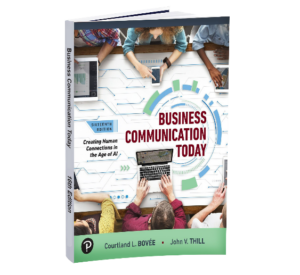
Business Communication Today is the ideal text for business communication instructors in this AI era because it seamlessly integrates the timeless principles of effective communication with cutting-edge advancements in artificial intelligence. Designed to address modern workplace challenges, this textbook provides a balanced approach to teaching essential communication skills while embracing the transformative impact of AI on business communication practices.
First, Business Communication Today emphasizes the foundational principles of communication—clarity, conciseness, and audience-centered messaging—that remain vital in any professional setting. These principles form the bedrock of successful communication, even as tools and channels evolve.
What sets Business Communication Today apart in the AI era is its proactive integration of AI concepts. The text equips instructors with strategies to teach students how to use AI tools as collaborators rather than replacements. From leveraging AI for research, drafting messages, and summarizing reports to creating visually impactful presentations, the book empowers students to work smarter and more efficiently. It emphasizes that AI, while powerful, cannot replace human judgment, creativity, and emotional intelligence, underscoring the importance of critical thinking when using AI tools.
Additionally, the text addresses ethical considerations surrounding AI in communication, such as avoiding biases, ensuring transparency, and maintaining credibility. It prepares students to navigate these challenges while upholding professional standards in digital and global communication contexts.
Business Communication Today remains relevant by incorporating real-world case studies from companies like Microsoft, Apple, and Coca-Cola. These examples demonstrate how businesses use AI for persuasive messaging, visual storytelling, and crisis communication, helping students bridge theory and practice.
In an era where AI reshapes every professional’s role, Business Communication Today equips instructors to future-proof their students, ensuring they thrive as thoughtful, tech-savvy communicators.
Neuroscience Meets Business Communication Education
This text integrates research-based principles from neuroscience to enhance learning. This innovative approach aligns with how the brain learns, retains, and applies information, transforming how business communication is taught and mastered. Imagine students who don’t just memorize concepts but confidently apply them. With engagement soaring and retention deepening, your classroom is where communication skills are mastered for life. Give your students the neuroscience advantage. Join leading colleges and universities already seeing remarkable results with our neuroscience-based approach.
